
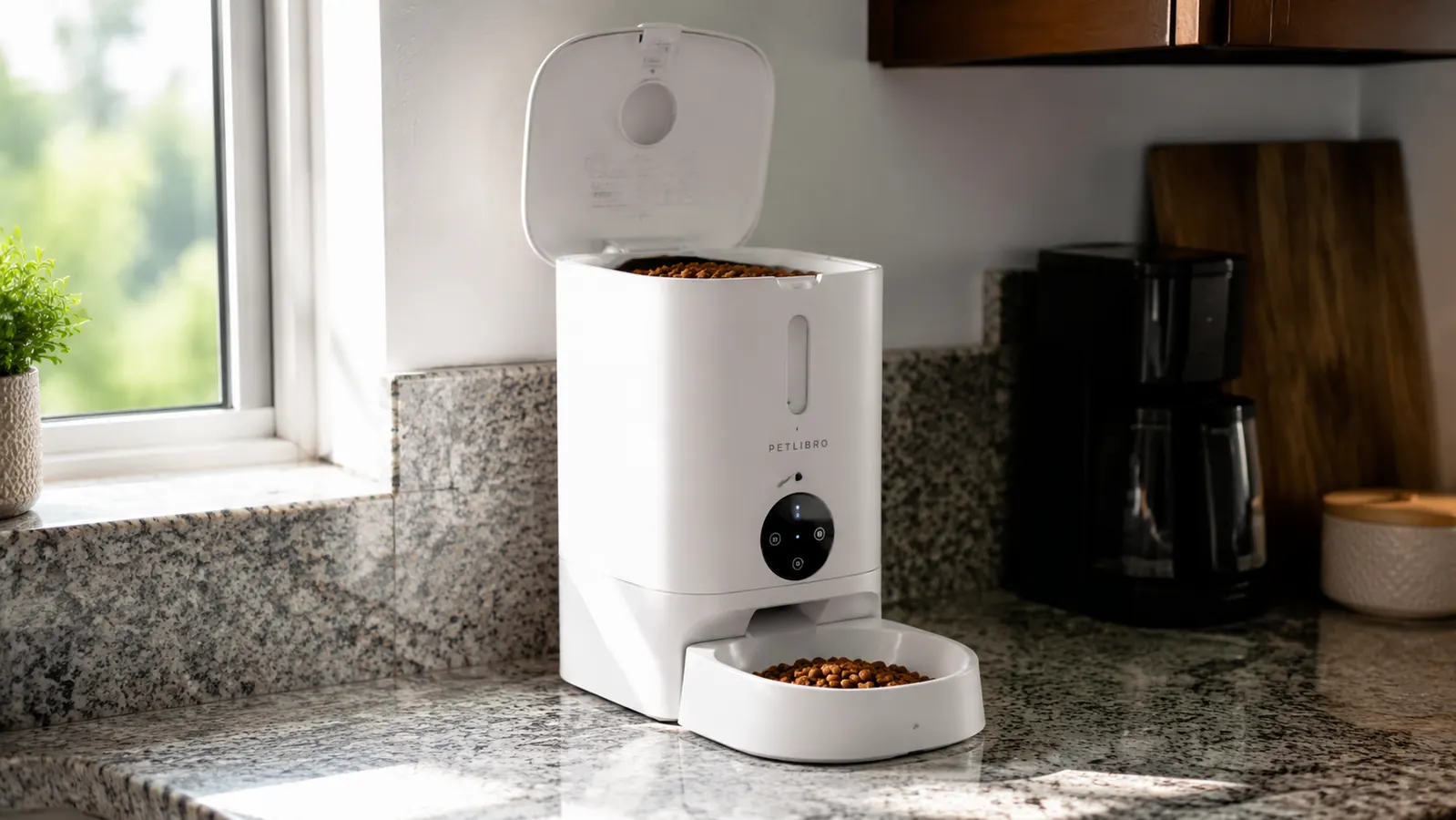
The HoneyGuaridan 3.5L automatic cat feeder has a 4.3-star average across more than 7,400 Amazon reviews. That number is genuinely earned. But buried in the 1- and 2-star reviews is a set of complaints that come up over and over, and nearly all of them point to the same few situations where this feeder is a bad fit. If you are in one of those situations, reading the star rating without reading the failure patterns will cost you the hassle of a return. We went through the negative feedback so you know exactly which questions to ask before ordering.
Our test cat for this piece is Cleo, a 7-year-old single-cat household Siamese mix, 8.5 lbs, with a habit of pacing at mealtimes and an outsized sensitivity to feeding disruption. Anxious eaters stress-test automatic feeders in ways that laid-back cats simply do not. Cleo gave us a clear view of the edge cases that matter.
The Quick Verdict
Solid feeder for straightforward dry-kibble households in the right physical space. A narrow but real set of situations turn it into a genuine mismatch. Know your situation before you buy.
Amazon Check Today's Price →If you have already ruled out the return triggers below, this feeder is worth a look at the current price.
The HoneyGuaridan 3.5L dispenses precise portions on a programmable schedule, uses a stainless steel bowl, and handles two cats without complaint. Check today's price on Amazon before you decide.
Amazon Check Today's Price on Amazon →What Buyers Are Surprised By
The first surprise for a lot of buyers is how loud the dispense cycle sounds in a small space. The auger mechanism on the HoneyGuaridan is a standard rotating drum design. When it fires, it produces a roughly two-second grinding-and-dropping sound. In a house with normal ambient noise, it registers as a soft mechanical whir. In a studio apartment, or any space where the feeder sits within ten feet of where you sleep, that sound at 6:00am lands differently. We tested Cleo's feeder in three positions: on the kitchen counter (loudest, resonates on the cabinet), on the floor against the wall (noticeably quieter), and on a rubber mat on the floor (quietest, mat absorbs vibration). Floor placement on a rubber mat made a real difference. Most buyers discover this through trial and error. We are telling you now.
The second surprise is more consequential: the feeder does not alert you when a scheduled meal fails due to a Wi-Fi drop. If the power blinks, the feeder runs on the built-in backup schedule without network connectivity. But if the Wi-Fi drops at exactly the wrong moment during a connected meal trigger, the meal is skipped silently. No push notification, no missed-meal log in the app. If you are the type of cat owner who checks the app throughout the day when traveling, you will not see a failure notice, you will just see that the last meal timestamp looks oddly old. For most cats this is recoverable. For anxious feeders like Cleo, a missed meal causes visible stress behavior that can run for hours after the delayed feeding.
The Kibble Jam Problem (and Exactly Which Kibbles Cause It)
Kibble jamming is the most common complaint in the negative reviews, and it is almost entirely a kibble-size and kibble-shape issue rather than a feeder defect. The HoneyGuaridan hopper opening is sized for small to medium round or cylindrical kibble. Pieces that are larger than roughly 12mm in any dimension can bridge across the opening under the weight of the full hopper above. The auger spins, moves no food, and the feeder shows a completed dispense in the app because it ran the motor for the scheduled duration.
The kibbles we saw cause bridging issues in our testing and in community reports: large breed or senior formula pieces that are triangular or star-shaped (Blue Buffalo Life Protection Large Breed, Hill's Science Diet Adult 7+), some freeze-dried raw toppers that clump slightly when mixed with kibble, and any kibble stored in a humid environment that has softened the outer coating even slightly. If your cat eats a small round kibble in the 8-10mm range (Royal Canin Indoor, Iams ProActive Health, Purina ONE Indoor Advantage), you are unlikely to see this issue. If your cat eats anything with an irregular shape or larger dimensions, do a manual dispense test on day one with the hopper about two-thirds full to see how it handles your specific food.
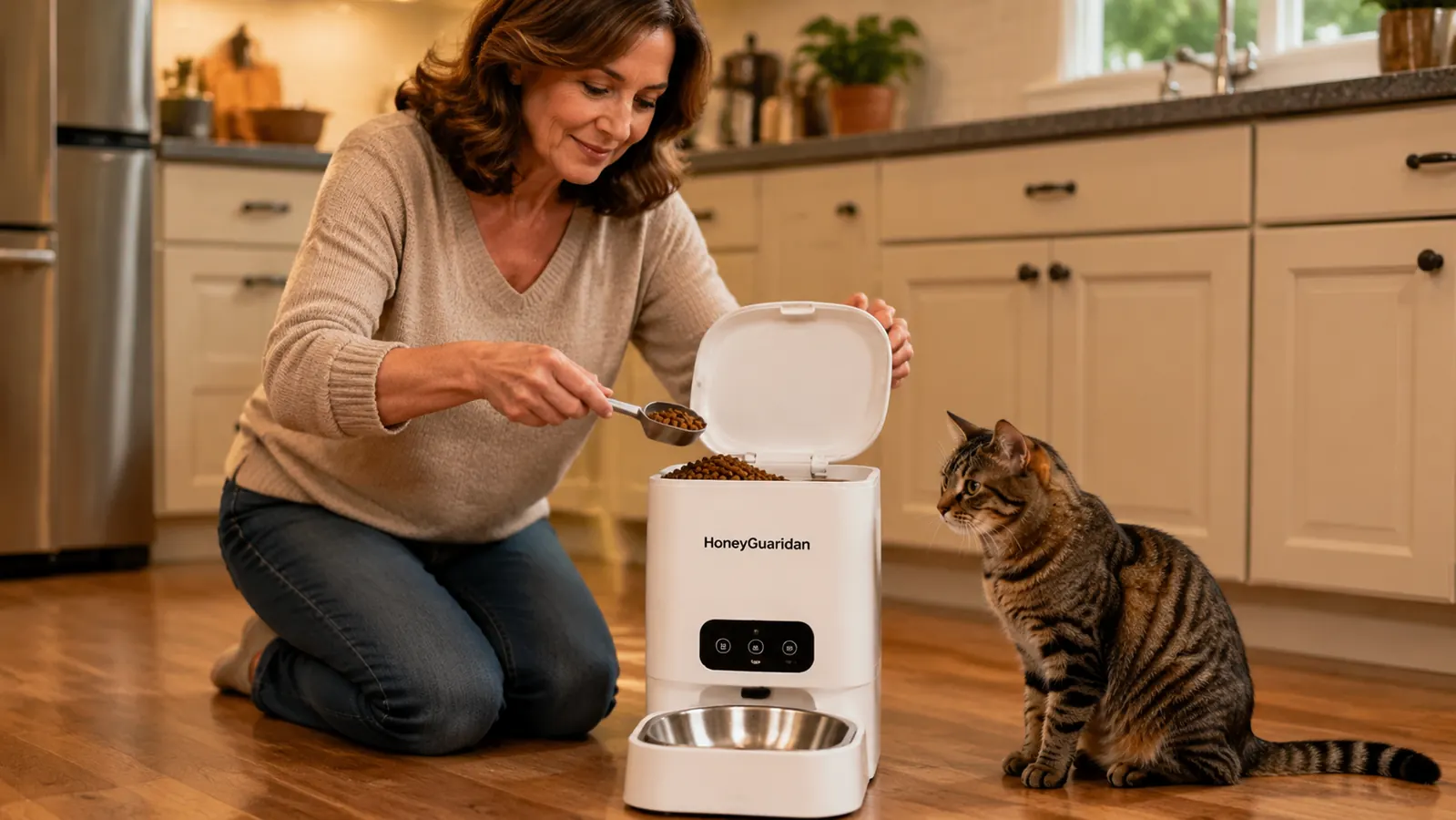
One thing the manual does not explain clearly: you can shake the feeder gently if you suspect a jam, and it will usually clear on its own. The design also has a small anti-jam groove near the auger exit. It helps with minor bridges but does not prevent a full horizontal span. If jamming is a recurring issue, adding a small mesh screen inside the hopper to break up clumps before they reach the opening is a modification some owners use, though it voids the warranty if you modify the hardware.
How Cleo Responded (and What Anxious Eaters Need to Know)
Cleo is a cat who paces in a tight figure-eight pattern for about five minutes before mealtimes once she has associated a time with feeding. That is not unusual for cats who have been hand-fed on a consistent schedule. What we wanted to know was whether she would transfer that anticipation behavior to the feeder, and how she would respond when the feeder dispensed.
The mechanical dispense sound caused a brief startle response on day one. She backed up about two feet, watched the food fall into the bowl, and waited roughly 90 seconds before approaching. By day three the startle was gone. By day five she was sitting in front of the feeder about fifteen minutes before scheduled meals, which is exactly the anticipatory behavior we were hoping to see. The transition went faster than we expected for a cat described by her vet as 'anxious about change.' The voice recording feature (the feeder plays a 10-second recorded message when it triggers) did help with the initial transition. We recorded a short phrase in a neutral tone, and Cleo responded to the familiar sound cue better than she did to the mechanical noise alone.
Where anxious cats do struggle is with the missed-meal scenario described above. The one time we had a Wi-Fi disruption cause a skipped dispense during our test period, Cleo's pacing behavior escalated beyond her normal pre-meal routine and persisted into the evening. That is a data point worth weighing if your cat has documented food anxiety. It is also worth noting that the voice recording feature, which gets promoted heavily in the listing copy, is genuinely hit-or-miss with cats. Cleo responded to it. Many cats in online community reports do not react to the recorded voice at all after the first few days and simply learn the mechanical sound on its own.
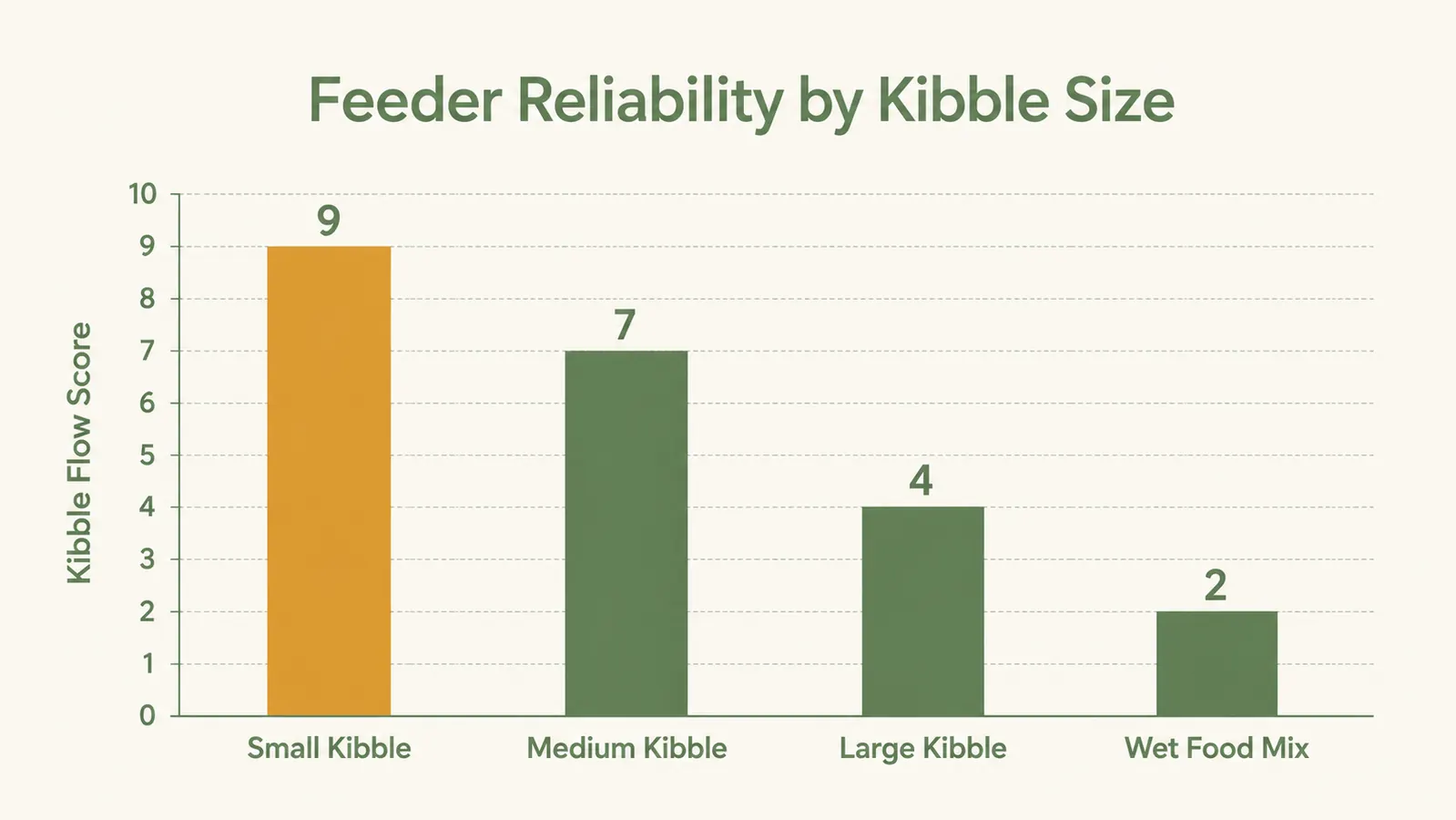
The return triggers are narrow and predictable. If you know your kibble size and your cat is not managing food anxiety on a medical level, the failure rate drops dramatically.
The App: What It Does Well and Where It Falls Short
The HoneyGuaridan app connects the feeder over 2.4GHz Wi-Fi only. If your home router runs a combined 2.4GHz/5GHz network with the same SSID (which most modern routers do by default), the feeder's setup process can fail repeatedly because your phone may be negotiating 5GHz during pairing even though the feeder needs 2.4GHz. The fix is temporary: during initial setup, disable the 5GHz band on your router or give the two bands different names. Once paired, the feeder maintains its own connection and you can re-enable 5GHz on the router without any further issues. This step is not in the printed quick-start guide, though HoneyGuaridan's customer support does mention it in their FAQ page. It is the single most common setup complaint in the negative reviews, and it is entirely solvable in under five minutes.
Beyond setup, the app is functional with some real gaps. Positives: you can set up to 12 daily meals, trigger a remote dispense from anywhere, see a log of completed meals, and adjust portion sizes without being near the feeder. That covers the core use cases well. Gaps: the meal log does not distinguish between a completed dispense and a failed-but-attempted one, the notification system sends a 'meal complete' push without confirming food actually moved (it just tracks motor runtime), and there is no portion calibration wizard that accounts for your specific kibble's density. If you are using this feeder for weight management with a precise gram target from your vet, you will want to verify actual dispense weights with a kitchen scale in the first week rather than trusting the app's portion numbers as-is. For more on using a feeder precisely for portion control, our guide on how to stop overfeeding your cat with an automatic feeder covers the calibration process step by step.
Build Quality and the Things People Return It For
The physical build is better than the price point suggests in most respects. The hopper is food-grade ABS plastic that does not carry odors from kibble after several weeks, which cheaper units sometimes do. The stainless steel bowl is removable and genuinely dishwasher-safe, which matters more than it sounds because the alternative is hand-scrubbing a curved bowl every few days to prevent grease buildup from kibble coating. The lid locks with a simple twist mechanism that cats cannot open, though a very determined cat with leverage access could potentially nudge the feeder enough to shift the lid. Cleo never attempted this. Cats who are more physically assertive about food might.
The return triggers we see repeatedly in the 1-star reviews break down into roughly four categories. First: kibble jams from the wrong food size, covered above. Second: app setup failure on routers with combined band SSIDs, covered above. Third: noise in a studio or small apartment where the feeder cannot be placed away from sleeping areas. Fourth: cats who refuse the feeder entirely, usually multi-cat households where one cat guards the bowl and the other cannot get access. That last scenario is a behavior problem rather than a feeder defect, and no single-hopper feeder will solve it, but the HoneyGuaridan listing does not caveat this clearly enough. If you have a multi-cat household where one cat dominates mealtimes, you need a dual-hopper feeder or two separate units. One unit placed in one location will not change the resource guarding dynamic.
How It Compares to What People Usually Switch From
Most buyers of this feeder are switching from one of three things: free feeding (leaving a bowl out all day), hand feeding on a set schedule, or a basic gravity feeder that just drops food as the bowl empties. Each of those starting points shapes how you will perceive the HoneyGuaridan.
If you are coming from free feeding, the feeder will feel like a dramatic upgrade in control and your cat will likely adjust within a week. If you are coming from hand feeding a consistent schedule, your cat is already trained to the timing, which means the transition is mainly about the cat accepting the mechanical dispense sound, and that usually takes three to five days. If you are coming from a gravity feeder, be aware that the HoneyGuaridan is considerably more complex in setup and maintenance but offers actual portion control that a gravity feeder cannot. The question is whether your cat needs controlled portions or just consistent availability. If your cat self-regulates well and does not overeat from a gravity feeder, the extra functionality of the HoneyGuaridan may not improve your situation enough to justify the step up. If your cat would eat themselves to illness from an open bowl, the portion control is the entire point. Our comparison piece on HoneyGuaridan vs PETLIBRO gets into how the portion accuracy stacks up against the main alternative at a similar price.
What I Liked
- Portion dispensing is consistent and accurate for small to medium round kibble
- Stainless steel bowl is dishwasher-safe and does not develop the bacterial biofilm that plastic bowls do
- Remote dispense from anywhere with cell service works reliably once the feeder is connected
- Anxious cats typically adjust to the mechanical dispense sound within three to five days
- Voice recording cue helps some cats transition faster from hand feeding
- 3.5L hopper capacity handles a typical single-cat household for roughly six to eight weeks between refills
Where It Falls Short
- No missed-meal alert if a scheduled dispense fails during a Wi-Fi drop
- Kibble bridging occurs with large, triangular, or irregular-shaped pieces over roughly 12mm
- Initial Wi-Fi setup fails on combined 2.4GHz/5GHz networks without a workaround step that is not in the printed guide
- Dispense sound is loud enough to disrupt light sleepers in studio apartments or rooms within ten feet
- App does not distinguish a completed dispense from a failed-but-attempted one
- Single hopper design does not resolve resource guarding in multi-cat households
Who This Is For
This feeder works well for single-cat households or two cats eating the same small to medium round kibble, where the feeder can be placed on the floor away from sleeping areas, and where the owner wants Wi-Fi-connected portion control without paying the premium that brands like SureFeed or Petkit charge. It also works well for owners who travel overnight one to three nights per week and need remote dispense capability as a backup. If your situation fits those parameters, the 4.3-star average reflects your likely experience accurately.
Who Should Skip It
Skip this feeder if your cat eats large-piece kibble with an irregular shape, if your living space means the feeder must be within eight to ten feet of where you sleep, if you have a multi-cat dynamic where one cat guards the feeding area, or if your cat is on a medical diet where a missed meal is a clinical event rather than an inconvenience. In any of those cases, the failure modes of this specific feeder are likely to create more problems than the feeder solves. There are alternatives in the same price range with different design tradeoffs, and the right choice depends on matching those tradeoffs to your actual household, not just buying the best-reviewed option on the list.
If your situation clears the hurdles above, the HoneyGuaridan earns its price for everyday dry-kibble feeding.
More than 7,400 owners have reviewed this feeder on Amazon. The failure patterns are real but narrow. Check current pricing and availability to make your call.
Amazon Check Today's Price on Amazon →